


Information about the author:
Valeria G. Andreeva
Valeria G. Andreeva, DSc in Philology, Leading Research Fellow, A.M. Gorky Institute of World Literature of the Russian Academy of Sciences, Povarskaya 25 a, 121069 Moscow, Russia; Professor, Kostroma State University, Dzerzhinsky St., 17, 156005 Kostroma, Russia.
ORCID ID: https://orcid.org/0000-0002-4558-3153
E-mail:
Abstract:
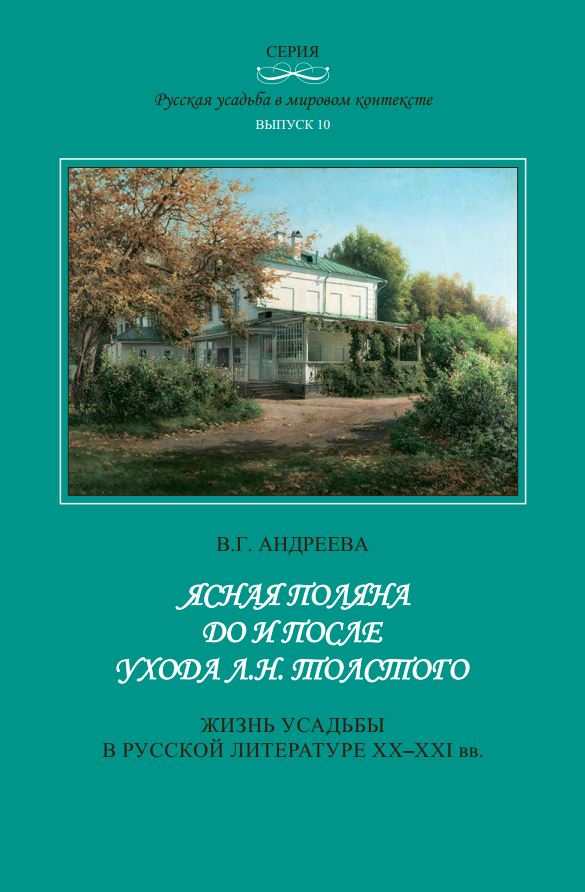
V.G. Andreeva’s new book examines the contradictions in Leo Tolstoy’s late views on estate life: on the one hand, an attachment to family estates, on the other, a sharp criticism of their status as owners, associated with the exploitation of people. Drawing on the great writer’s works and the memoirs of his relatives and assistants, the book explores the estate traditions of the Tolstoy family from the 1880s to the 1910s, identifies and examines estate motifs in Tolstoy’s late works, and demonstrates the development of the image of the estate house in close proximity to nature. Even during Tolstoy’s lifetime, Yasnaya Polyana became a place of worldwide pilgrimage, seeking to see the Russian estate as a site of the classic writer’s economic experiments and literary works. The flow of visitors continues unabated — the estate museum has become a powerful transmitter of the creative energy of one of the most prominent creators of the “estate text” in Russian literature. Particular attention is given to the topic of Yasnaya Polyana in documentary and fiction literature of the 20th and 21st centuries. The reception of Tolstoy’s motifs and images, which constitute the “estate” tradition of Russian literature, is studied in the works of Soviet (M.A. Sholokhov, M.M. Prishvin, B.L. Pasternak, K.A. Fedin, M.A. Bulgakov, K.G. Paustovsky, B.Sh. Okudzhava) and post-Soviet (G.N. Vladimov, V. Staroy, V.O. Pelevin, P.V. Basinsky) writers. It is established that Soviet authors often implicitly affirmed the estate’s values, while post-Soviet ones update them using the artistic tools of the postmodern era. This publication is intended for literary scholars, historians and cultural studies scholars, as well as students and all interested readers.
Keywords: L.N. Tolstoy, Yasnaya Polyana, Estate, “Estate Topos”, “Estate Locus”, Reception, Soviet Literature, Estate-Museum, Pilgrimage, Russian Literature of the Late 20th–21st Centuries


