
Information about ex. editors:
Tamara V. Kudryavtseva
Tamara V. Kudryavtseva, DSc in Philology, Director of Research, А.M. Gorky Institute of World Literature of the Russian Academy of Sciences, Povarskaya 25 а, 121069 Moscow, Russia.
ORCID ID: https://orcid.org/0000-0002-8279-8639
E-mail:
Alla A. Strelnikova
Alla A. Strelnikova, PhD in Philology, Associate Professor, State University of Education; Senior Researcher, A. M. Gorky Institute of World Literature, Russian Academy of Sciences, Povarskaya St., 25a, 121069 Moscow, Russia.
ORCID ID: https://orcid.org/0000-0002-2887-7678
E-mail:
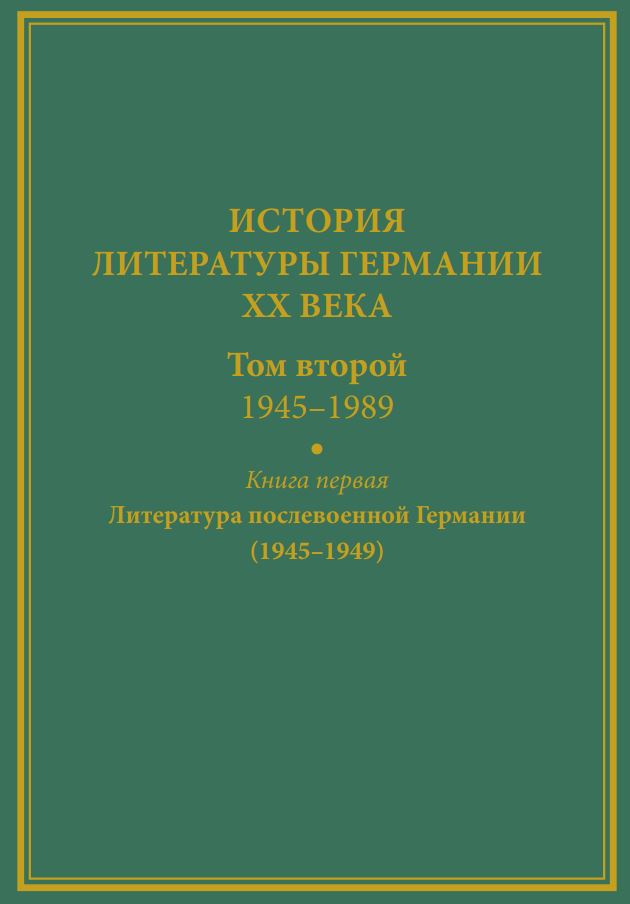
The first book of Volume II of the History of 20th-Century German Literature examines the specific characteristics of the literary process in post-war Germany (1945–1949). It aims to revise the prevailing view in Russian and German-language literary scholarship — which often treats German literature of this period merely as a dependent prelude to the separate literatures of the GDR and the FRG — by demonstrating its intrinsic significance. The book explores the key thematic and aesthetic constants of the literary process at the juncture of two historical eras, highlighting both their shared and contrasting features. It investigates the distinctive content and stylistic qualities of the major movements, schools, and groups that shaped the post-war German literary landscape, such as Socialist Realism, Existentialism, Magical Realism, religiously oriented literature, and “Group 47.” Separate chapters address the crucial philosophical, political, and ideological factors of the period, paying particular attention to how cultural policies in the Western and Eastern occupation zones shaped literary development. Overview chapters examine the distinct features of drama, prose, and poetry, while also exploring broader elements of the literary field, such as radio plays and children’s literature, noting how they evolved differently in the West and East. Furthermore, the work of individual writers is analyzed in relation to its origins, its influence on subsequent generations, and its close connection to contemporary sociocultural realities. This analysis is set against the broader literaryhistorical context of related German-language literatures, taking into account genetic connections and typological parallels with other European and American literatures. The volume holds both theoretical and practical significance for the study of foreign literatures. It is intended for philologists, as well as graduate and undergraduate students specializing in German studies.
Keywords: literary process, post-war Germany (1945–1949), history of foreign literature